Maarten Alexander Brems completes doctorate
Eduard Visintini completes his doctorate
Philip Lambrix publishes his doctoral dissertation
13.-14.03.2026 Network Weekend
20.04.2026 Welcome Ceremony
19.06.2026 Network Meeting
Do you want to stay up to date on what is happening in and around the Gutenberg Academy Fellows Program | GAFP? Subscribe to our GAFP-Newsletter now!
Scientific exchange and grants at the highest level
The Gutenberg Academy Fellows Program (GAFP, formerly known as Gutenberg Academy (GA)) is an institution of Johannes Gutenberg University Mainz (JGU) and was founded in 2006. It brings up to 25 of the university’s best doctoral researchers and artists (junior fellows) together and provides them with the chance to participate in an interdisciplinary exchange of ideas at the highest intellectual level. These students have the opportunity to interact and engage in discourse with excellent researchers and artists (senior fellows and associate fellows). Through financial support and a specific sponsorship and mentorship model, the junior fellows are supported on their professional path into science and art. The program’s central focus is on the interdisciplinary exchange of ideas and on individual development and networking.
Networking
Not only does the GAFP promote interdisciplinary exchange between excellent young talents (junior fellows) and established researchers at the university (senior fellows and associate fellows), but it also establishes contact with former fellows from JGU (alumni and alumnae of the GAFP) and with people and career networks outside the university.
Interdisciplinary Exchange
The Gutenberg Academy Fellows Program provides an interdisciplinary forum for maintaining a continuous exchange of interdisciplinary scientific information. The GAFP’s unique status results from the association of scholars from different generations and different scientific fields of research, who are able to benefit from each other by gaining outside perspectives of their respective work in one particular subject area. Free from constraints that govern academic work at the university as a whole, the Gutenberg Academy Fellows Program allows for a reclassification and re-contextualization of expert knowledge. The GAFP provides senior fellows, associated members, and junior fellows the possibility to work with outstanding scientists from varying disciplines within the university on their particular research topics, as well as on general questions of scientific and academic relevance. Within the university, the GAFP creates spaces for networking beyond research activities and across departments, thus promoting the identification of its members with the university as a whole.
Did you know? The GAFP also has its own YouTube channel where the junior fellows present themselves and their research in short videos.
Junior fellows are entitled to financial support of up to EUR 2000 for a maximum of 2 years as a member of the program. EUR 1000 can be claimed annually.
Applications can be submitted for the following services:
1. for travel to participate in specialist congresses, research workshops, etc. that are connected with official activities (excluding daily allowance)
2. for travel costs incurred as part of the GAFP, such as for traveling to meet with external mentors (excluding daily allowance)
3. expenses resulting from a pursuit of the dissertation goals
…following the time as a fellow
If junior fellows successfully complete their dissertation, the printing costs incurred for the publication of their doctoral dissertation following their time as a fellow can be subsidized. These funds are independent of the above-mentioned financial support option and amount to a maximum of EUR 3000.
In addition to providing financial support for completing the dissertation, which frees fellows up to work and develop as individuals, membership in the GAFP enables expert knowledge to be reorganized and recontextualized. An exclusive sponsorship and mentoring model is available to junior fellows for this purpose.
The internal sponsorship offers the possibility to build an intensive exchange within the university that transcends the borders of a single subject. Junior fellows can choose an internal sponsor from among the senior and associate fellows of the GAFP for the period of their time as a fellow. This sponsor will give them a different professional perspective on their doctoral dissertation.
In addition, junior fellows can choose external mentors for the duration of their time as a fellow, based on their own professional goals and academic interests. The mentors will advise and support them in their further career. They are proven experts from science, the arts, culture, politics, business, or society who broaden the mentee’s view of the dissertation project and beyond, and also provide contacts and networks for their future career.
Once a year, at the beginning of the summer semester, the GAFP’s welcome ceremony takes place, at which new fellows are ceremoniously greeted by the President or a Vice President of JGU and the spokespersons, and are admitted to the GAFP. The departing senior and junior fellows are given a dignified farewell.
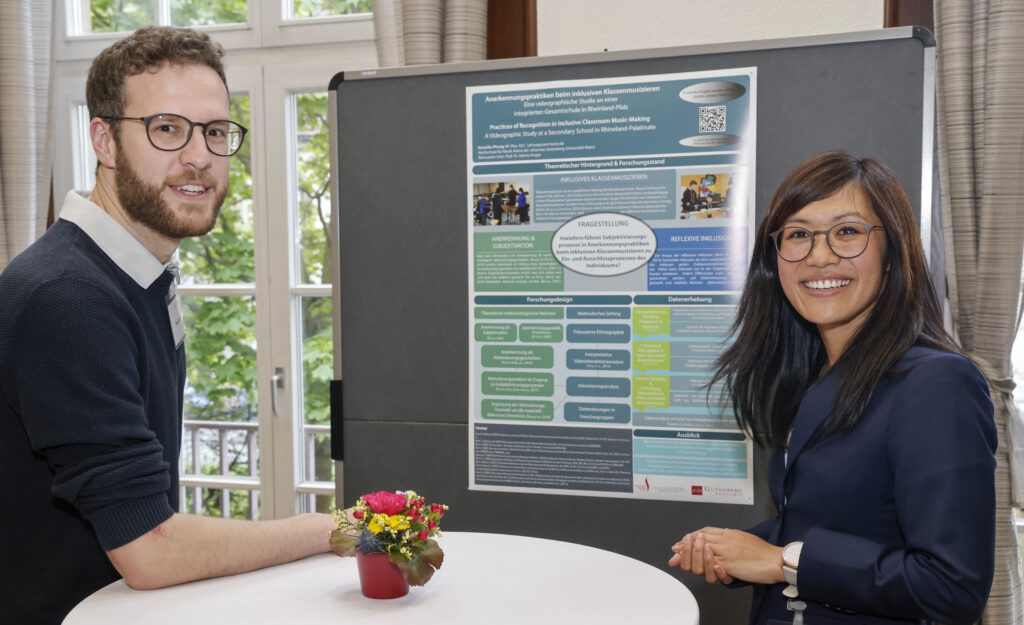
During the ceremony, newly admitted fellows have the opportunity to meet both active and former fellows of the GAFP for the first time. They also present their dissertation projects in a poster forum.
At the annual network weekend, the new junior fellows present their dissertation or art projects to the existing fellows at an internal two-day conference. The exchange between doctoral students, artists, junior professors, and professors provides new impulses for the respective work.
The network meetings have been taking place since 2018 and are a great opportunity for all GAFP fellows to meet in a relaxed atmosphere. Active and former fellows can exchange ideas and get to know each other during an interesting program – at a concert, a guided tour or a lecture, often away from the university campus – followed by a buffet. The aim of this event is to maintain and build relationships and strengthen cohesion. A special feature of the network meetings is that the members step out of the university environment and gain other, exciting insights into the region.
Towards the end of each year, the study trip takes place, during which the junior fellows of the GAFP travel somewhere for three days for study purposes and to experience education, art, and culture. The junior fellows choose the destination themselves and organize the program at the location. Academic exchanges and internal networking are continued away from university life. Previous destinations have been Budapest (2009), Istanbul (2010), Riga (2011), Bilbao (2012), Lisbon (2013), Athens (2014), St. Petersburg (2015), Geneva (2016), Venice (2017), Seville (2018), Lisbon (2019), Leipzig (2021), Copenhagen (2022), Vienna (2023), and Milan (2024).
Round table events are evening events with scientific presentations on various topics followed by informal discussions among GAFP fellows. Sporadically, they take the form of an excursion with lectures on site. For example, the Max Planck Institute for Polymer Research in Mainz and Faculty 06: Translation, Linguistics, and Cultural Studies in Germersheim have already been visited.
Cooperations
The GAFP is a funding institution for young researchers and has close ties to other JGU bodies founded to improve teaching, research and the promotion of young researchers – the Gutenberg Research College (GRC), the Gutenberg Council for Academic Careers (GCC, formerly the Gutenberg Council for Young Researchers (GYR)), and the Gutenberg Teaching Council (GTC). Several senior fellows of the GAFP are also members of these bodies. Against this background, a cooperation event between the GAFP and the GRC, GCC and GTC takes place once a year. Since 2021, round tables have also been held in cooperation with the Gutenberg Graduate School of the Humanities and Social Sciences (GSHS).
The focus is on selected areas of academic work and university-academic operations; depending on the partner institution, the emphasis is on either research or teaching. The fellows of the GAFP and the other bodies as well as invited speakers discuss various topics of research and scientific practice or aspects of good teaching and the compatibility of teaching and research at this cooperative round table event.
Thus, the round table events provide a forum for active and former fellows to meet, and enable alumni to maintain contact with the GAFP and its fellows or to contribute to the organization of the round table events through guest lectures.
Previous Round Table Events
Discussion on ‘Doing Research Abroad‘ (01.12.2025) in cooperation with the Gutenberg Graduate School of the Humanities and Social Sciences (GSHS)
When is the right time for a research stay abroad? How do I build up an international network? To what extent does internationality in research act as a career driver? How can I actually carry out an international research stay? And international research – in what form is this even possible and for what exact purpose?
Maarten A. Brems, former Junior Fellow of the GAFP, Dafina Gashi, member of the GSHS, Prof. Dr. Nico Nassenstein, Professor of African Studies (JGU) and former Associate Fellow of the GAFP, and Prof. Dr. Virginia Gail Toy, Professor of Structural Geology and Tectonics (JGU), provided answers and tips to these and other questions during the cooperative round table. They presented their personal career paths and explained the reasons and considerations for their actions. The moderators of the evening, Marie Schlosser and Isabell Zipperle (both Junior Fellows of the GAFP), initiated an exchange in two small groups following the personal assessments of the speakers, before the most important findings were summarized for everyone in the plenary session at the end of the event. The speaker of the GAFP, Prof. Dr. Acquavella-Rauch, and the director of the GSHS, Prof. Dr. Schneider, thanked all participants and concluded the event with a concise summary of the round table’s findings. The event was held in English.
Exchange on the topic ‘How can one take action against the abuse of power in science?’ (May 26, 2025)
The event began with the first few minutes of the Deutsche Welle (DW) documentary, “How Germany’s elite research institution fails young scientists.” The excerpt clearly showed the explosive and topical nature of the topic of this round table event. The central question of the evening, “How can one take action against the abuse of power,” was addressed by the invited spokespersons. Prof. Dr. Alfred Hornung reported on his experiences as an ombudsperson at JGU, talked about who to contact, and explained the differences between combating abuse of power in research institutions and in the private sector. Tina Rotzal, Head of the Competence Center for Research Integrity at JGU, spoke about her experiences as an ombudsperson and presented various prevention and support services. Katharina Kleinlein (h&z Management Consulting), on the other hand, placed the topic of abuse of power in an overall German context and described both structural obstacles and options for effective prevention.
The lively exchange between speakers and participants following the presentations dealt with various questions: Are professors aware of their position of power? How effective are “mandatory leadership trainings,” and how regularly should they take place? To what extent does survivor bias play a role? Why are the police not called in cases of abuse of power? Both the participants and the speakers raised important points, including the involvement of doctoral candidates in strategic preventive work, the need to translate information texts and documents for non-native speakers, and compliance with the supervision agreement. And although some parts of the exchange were discouraging, as the necessary changes to prevent abuse of power in academia are still a long way off, it was also hopeful in equal measure: only if attention is paid to the issue, if it is repeatedly discussed, and all those involved are made more aware, can an environment be created in which those affected are given a voice. In this way, the rigid structures that currently stand in the way of effective prevention can be changed over time. The event was held in English. You can find the presentation from the evening (including the speakers’ slides) at: https://gafp.uni-mainz.de/wp-content/uploads/sites/110/2025/06/alles-umfassende-PPP.pdf. Information from HR Development on the topic of “Annual interview” can be found at: https://www.personalentwicklung.uni-mainz.de/jahresgespraeche/materialien/.
Exchange on the topic “Science – an attractive career path?” (25.11.2024) in cooperation with the Gutenberg Council for Young Researchers (GYR)
How exactly does your personal career path continue after your doctorate? Do you remain in the university context in research and teaching, perhaps even pursue a habilitation? Or does the path lead out of university life and into the private sector? And what should be considered when making such decisions? What is important to each person? What personal values and attitudes influence future career planning? Is there really such a thing as luck and bad luck in career planning? How can setbacks be overcome?
Dr. Judith Hankes, Partner at aestimamus, Prof. Dr. Ashok Kaul, Senior Partner at Roland Berger and Professor of Applied Artificial Intelligence, Prof. Dr. Andreas Keller, Professor of Clinical Bioinformatics, Prof. Dr. Katja Schupp, Professor of Journalism, and Prof. Dr. Andrea Tüttenberg, CEO/CMO ActiTrexx GmbH and senior physician at the Department of Dermatology (on temporary leave of absence), provided answers and tips to these and other questions during the cooperative round table event. They presented their personal career paths and explained the reasons and considerations for their actions. Following the short presentations, each lasting 5 to 10 minutes, all participants had the opportunity to engage in informal personal discussions with the speakers. At the end of the event, the most important findings were summarized for everyone in the plenary session. The event was held in German.
Discussion on the topic “Show Me The Money – How do I apply for a third-party funded project?” (July 8, 2024) – in cooperation with the Gutenberg Research College (GRC)
Obtaining funding for research projects is not always easy. Even experienced scientists fail to do so. In addition to the way in which the need for research can be plausibly and convincingly explained, other fundamental questions arise: How do I proceed if I have a research idea and want to implement it in a project? What and who has helped me with previous proposals? Are there special offices/persons at JGU for this? What should I pay attention to? What was difficult or should be avoided? How do I proceed if I am planning a research collaboration and need to find partners?
Julia Doré, EU Officer and Head of the Research Funding Unit at JGU, and Prof. Dr. Marion Silies, Professor of Neurobiology, provided answers and tips to these and other questions during the cooperative round table event. The discussion highlighted the desire of younger researchers in particular for greater exchange among themselves and with more experienced co-workers, but also between the very different specialist cultures in the humanities and social sciences as well as the natural and life sciences. Information events and workshops on planning and writing proposals were proposed. The event was held bilingually.
Discussion on the topic “The Dual Face of AI: Illuminating Opportunities and Challenges in Academia and Work” (May 6, 2024)
Artificial intelligence (AI) can be found in many headlines these days. However, the effects of the increasing integration of AI into the working world are rarely taken into account. Smaller, supplementary tasks in particular are increasingly being replaced by AI-supported programs. However, new employment and earning opportunities are also opening up, for example for obtaining financial security during the qualification phases. In a panel discussion, these positive and negative aspects of the integration of AI into everyday working life and employment opportunities in and outside of science were highlighted.
Both senior and junior fellows of the Gutenberg Academy Fellows Program took part in this event. There were also keynote contributions: The first keynote by Dr. Andrea Klein highlighted the potential impact of AI on science, encompassing upcoming changes in both research and teaching. The second lecture by Janis Ebert showed two sides of artificial intelligence, the benefits in pathology and especially in cancer research, but also the social challenges in the context of the modern daily use of “social” media and the recommended algorithms.
The participants had the opportunity to discuss various aspects of these topics and ask the experts questions in the plenary session. The event was held in English.
Discussion on “Academic Freedom in Germany” (July 3, 2023) – in cooperation with the Gutenberg Research College (GRC)
On July 3, 2023, a round table was organized in cooperation with the GRC on the topic of “Academic Freedom in Germany.” The first guest speaker, Prof. Dr. Richard Traunmüller, is Professor of Empirical Democracy Research at the University of Mannheim. In his contribution, he dealt with the question of whether the popular phrase ‘cancel culture’ threatens academic freedom in Germany. In his contribution, he established that both popular positions on the polarizing topic of ‘cancel culture’ are not sufficiently supported by empirical evidence. The second guest speaker, Prof. Dr. Klement Tockner, is Director General of the Senckenberg Gesellschaft für Naturforschung and also Professor of Ecosystem Science at Goethe University Frankfurt am Main. His contribution focused on the underlying statistical data on the topic of academic freedom in Germany, particularly in comparison with the rest of the world. For example, he also outlined the distribution of financial support for science by various instances and institutions. After the two expert presentations, members of the GRC and the GAFP engaged in a stimulating discussion on the content of the two presentations and the overarching topic of academic freedom in Germany.
Discussion on the topic “Activism in Academia” (May 24, 2023)
In times of both new and well-known crises, such as the climate crisis, it is not only the broad mass of the population that is called upon to actively campaign for change. Even scientists have to ask themselves time and again whether and how they should take a stand on various issues. These and many other questions were discussed together with our guest speakers, Prof. Dr. Sebastian Seiffert (Professor of Physical Chemistry of Polymers at JGU and climate activist at Scientists for Future) and Nathália Antonucci Fonseca (social anthropologist and founder of LGBT+Movimento, research on affects and governance among/of Venezuelan LGBTTQIA+ migrants and refugees in Rio de Janeiro, Phd student at UERJ & JGU Mainz). Seiffert used his career path as an example for showing how quickly political intentions are often seen as a reason for the dissemination of scientific facts. He is also certain that everyone is an activist to some extent, even if they don’t think they are. Fonseca’s contribution to the round table makes it even clearer that the status of activist is an integral part of the scientist. As part of the LGBT+ community, you never have the choice of activism because the issue is inextricably linked to you as a person. In the course of the round table event, it was jointly established that it is unrealistic to demand total neutrality from scientists.
Discussion on the topic “Between Privilege and Precarity: The Many Facets of Doing a PhD in Germany” (March 27, 2023) – in cooperation with the Gutenberg Graduate School of the Humanities and Social Sciences (GSHS)
On March 27, 2023, a round table was organized in cooperation with the GSHS on the topic “Between Privilege and Precarity: The Many Facets of Doing a PhD in Germany”. The first guest speaker, Dr. Sarah Widany, project leader of the National Academics Panel Study (NACAPS) at the German Centre for Higher Education Research and Science Studies, presented the current scientific findings on forms of precarity and diversity during the doctorate and their impact on future academic careers. The second guest speaker, PD Dr. Kristin Eichhorn, Deputy Head of the Department of Modern German Literature at the University of Stuttgart’s Department of Literature and co-initiator of the #ichbinhanna Twitter campaign and co-author of the book with the same title, explored reform proposals and conclusions that have emerged from the #ichbinhanna campaign regarding the situation of doctoral candidates in Germany for the WissZeitVG after more than a year. After these two contributions, a stimulating discussion developed among members of the GAFP, the GSHS, and the guests from the partner universities in Frankfurt am Main and Darmstadt, especially about the state of the doctoral process in Germany.
Discussion on the topic “Roles of scientists in political decision-making” (14.12.2022) – in cooperation with the Gutenberg Council for Young Researchers (GYR)
At the end of the year, the annual “Christmas Round Table” was once again held as an online format in cooperation with the Gutenberg Council for Young Researchers (GYR). The question of how (young) scientists can become involved in policy advice was discussed. Three speakers were invited to give different theoretical and practical insights in their keynote speeches. Mr. Tome Sandevski (Head of the Mercator Science-Policy Fellowship Program at the Goethe University Frankfurt a.M.) gave a practically oriented overview of policy advice instruments. One focus was on what scientists can do to contribute their expertise as effectively as possible to the political process. Professor Norbert W. Paul (head of the Institute for the History, Theory and Ethics of Medicine at JGU) then spoke about his experiences advising on requests from politicians, e.g., in connection with the Transplantation Act or the prioritization of corona vaccinations. He emphasized the importance of distinguishing between the role of a scientist, who provides a scientifically based analysis and recommendations based on this, and his role as an individual (as well as maintaining his scientific independence) when advising. He is involved in political advising as a global citizen who has the opportunity and, therefore, the responsibility to make a difference. The third speaker, Mr. Roland Bednarz (co-coordinator of the Scientists4Future group at JGU), also shared these views. In his concluding keynote speech, he discussed how scientists can communicate topics and aspects relating to the climate crisis to the public in an understandable way and stimulate discussion. He invited participants from all disciplines to take part in Scientists4Future. After the keynote speeches, the participants exchanged views in four groups on their personal positions and discussed the “moral obligation” to provide policy advising, as well as the challenges and opportunities of policy advising, but also the exchange with the interested public in general. Finally, the plenary session discussed possible approaches for further training courses for (young) researchers, including guidelines for good scientific practice in policy advising, ethics, and rhetoric courses as well as courses to train media skills and science communication.
Discussion on “Science and Entrepreneurship” (June 20, 2022) – in cooperation with the Gutenberg Research College (GRC)
The topic of alternative career options in science is frequently discussed these days. The question of how to turn a research project into a business start-up is therefore one of the issues that doctorates and young researchers will have to deal with during their research process sooner or later. Professor Petra Ahrweiler (Institute of Sociology, JGU) gave an introductory lecture on external factors and university conditions that can promote or hinder innovation management and entrepreneurship. Speakers Christine Göhring and Alexandra Fischer (Startup Center, JGU) provided insights into the university’s internal processes and contact points that support scientists in founding a company at JGU. Further interesting impulses were given by Dr. Rebecca Matthes and Dr. Philip Dreier (founders of Advylop), who described their path from doctoral dissertation to the pending company foundation. Among other topics, the following aspects were discussed in the subsequent discussion: What skills do doctorate students and young researchers need to start a business? Is entrepreneurship an indicator of academic excellence? What is the Startup Center and how does it support young scientists who want to found a company? Does JGU provide further assistance in this area?
Discussion on the topic ” The War of Aggression Against Ukraine – What Does It Mean for Us as a Scientific Community?” (May 25, 2022)
Russia’s war of aggression against Ukraine, which broke out in February, presents the world with an unknown situation and far-reaching consequences. With this in mind, the questions arise: What can we, as a scientific institution, do in this situation? What does the war mean for us as a scientific institution? What is our responsibility as scientists? These and other questions from the floor were discussed by our guest speakers. Igor Mitchnik (founder and former head of the civil society center “Drukarnia”, former fellow of the Mercator Program for International Affairs) and Dr. habil. Olena Strelnyk (sociologist with a research unit [as a part of the research initiative 2008-11] on the situation of women from national minorities, visiting researcher as part of the program for the grant of Ukrainian academics at the Technical University of Munich), presented Ukraine-specific perspectives, while Dr. Dani Kranz (DAAD long-term visiting professor at Ben-Gurion University in Israel) offered an international perspective. At the beginning of the round table, Igor Mitchnik gave a comprehensive overview of the historical and political development of the conflict. Dr. habil. Olena Strelnyk, with her expertise in the fields of gender studies, equality and human rights, and her personal experience as a Ukrainian academic, was able to provide information on the impact of war on women. Dr. Dani Kranz presented an international perspective on asylum laws and regulations. The round table event took place online.
Discussion on the topic “Globalization and International Networking / Opportunities” (February 7, 2022)
As globalization continues, it has become increasingly common for academics to spend at least part of their career abroad. This presents young scientists with unfamiliar challenges and raises questions, particularly with regard to international networking: How can we bridge the differences between different research and academic cultures? How can we “sell” ourselves as scientists on an international market? How can we best build an international network for ourselves? And what resources are there for international researchers when they go abroad?
These and other questions from the floor were discussed by our guest speakers. Dr. Nicole Birkle (EU Officer of the EU Office Research and Technology Transfer Department JGU, member of the speaker team of the work group ROSE: Research on Societies in Europe) and Dr. Nina Straub (Research Manager EU Funding Research and Technology Transfer Department JGU, FIT Forthem) offered insights into the topic from within the university and Europe-wide, while Ms. Valentina Rabanal (Officer of YESS, master’s degree student at the University of Buenos Aires) presented an international perspective. Professor Peter Gröschler (Chair of Private Law and Roman Law) shared his personal experience of international exchange opportunities in an interesting keynote speech. The round table event took place online.
Discussion on the topic “Under pressure: Early Career Researchers and Parenting” (13.12.2021) – in cooperation with the Gutenberg Council for Young Researchers (GYR)
At the end of the year, our traditional “Christmas Round Table” took place again in cooperation with the Gutenberg Council for Young Researchers (GYR). The question of what JGU can do to relieve the burden on young researchers with children was discussed. The aim was to collect ideas for JGU. In two groups, the challenges for young researchers with children were discussed and solutions were proposed, including: more visibility for the topic, strengthening the family-friendly culture at the university with regard to work and student-teacher ratios, planning events and meetings with the needs of parents in mind, and networking and granting young researchers with children the opportunity to exchange ideas. The round table event took place online. JGU’s Family Service Office participated.
Discussion on “Academic Integrity” (November 15, 2021) – in cooperation with the Gutenberg Graduate School of the Humanities and Social Sciences (GSHS)
In light of the data falsification scandals of recent years, which have also affected renowned researchers and top politicians, academic integrity continues to be the focus of discussion regarding higher education policy. Dr. Jeanne Ruffing (Managing Director of the GSHS), Prof. Dr. Cornelis Menke (Director of the studium generale) and Prof. Dr. Martin Michel (Head of the Urogenital and Cardiovascular Pharmacology working group) provided comprehensive general and subject-specific information on the underlying quality assurance processes in supervision and assessment. Among other things, the following aspects were discussed in presentations and in the subsequent discussion: What are the differences in knowledge production between the humanities and natural sciences? To what extent do discourses on genius and originality encourage research misconduct? What does it even mean to generate “knowledge” in my subject and with the methods I use?
>> Presentation by Dr. Jeanne Ruffing
>> Presentation by Prof. Dr. Martin Michel
>> Presentation by Prof. Dr. Cornelis Menke
Discussion on the topic “Balancing Family Life and an Academic Career” (May 17, 2021)
How compatible are family and an academic career? Which experiences have been made across Germany and internationally in this regard? How is the issue being addressed by local initiatives, international funding agencies, and the university? What measures can be taken and how can the topic be discussed in order to improve the situation for young academics? These and other questions were discussed at the round table with the two guest speakers Prof. Dr. Katja Schupp, Professor of Journalism at JGU Mainz, co-founder of the “Parents in the Gutenberg Academy” initiative, and Danilyn Rutherford, PhD, anthropologist, president of the Wenner-Gren Foundation. Interesting keynote speeches highlighted national, university-wide and international perspectives. The round table event took place online.
Discussion on the topic “Research Data Management ” (June 14, 2021) – in cooperation with the Gutenberg Research College (GRC)
Dr. Johannes Liermann (Department of Chemistry at JGU, co-spokesperson of the “NFDI4Chem” consortium) and Jun.-Prof. Dr. habil. Stefanie Acquavella-Rauch (Institute of Art History and Musicology, associate fellow of the Gutenberg Academy) provided comprehensive general and subject-specific information. Among other things, the following aspects were discussed in the presentations and in the subsequent discussion: How do I store and structure my research data? What security and legal aspects need to be considered? Which software can I use? How can I make my research data available to other scientists?
Discussion on the topic “Between “Improving” and “Impeding”: The COVID-19-Pandemic and its Impact on Teaching & Supervision, Research, and Career Development” (14.12.2020)- in cooperation with the Gutenberg Council for Young Researchers (GYR)
In the format of a collegial exchange, the participants in this round table reflected on the past year and some of the challenges that society was suddenly confronted with in 2020. In particular, the COVID-19 crisis and its impact on teaching, research, and career development of the university community as well as the associated digitalization were discussed. The participants were experts from the higher education institution. The aim of the round table event was to incorporate the ideas and experiences into future JGU decisions. The event took place online and in cooperation with the Gutenberg Council for Young Researchers (GYR).
Discussion on the topic “Strategic and Conceptional Development Lines of Digital Academic Teaching” (November 16, 2020)
In light of the current situation – the coronavirus pandemic – and against the backdrop of experiences from the 2020 summer semester, this round table addressed the topic of digital teaching and raised various perspectives on what the long-term direction will be and how it should be assessed. Two guest speakers shed light on state and university-wide perspectives in interesting keynote speeches: Dr. Konrad Faber, Managing Director of the Virtual Campus Rhineland-Palatinate (VCRP) and Dominik Schuh, member of the team of the Vice President for Learning and Teaching at JGU. The round table event took place online.
Discussion on the topic “Communicating Science” (June 15, 2020) – in cooperation with the Gutenberg Research College (GRC)
Junior Professor Dr. Verena Brinks (associate fellow of the Gutenberg Academy) gave a lecture on communication by experts in crisis situations. Prof. Dr. Matthias Schott (member of the Gutenberg Research College) provided information on the possibilities of communicating research outside of everyday university life (e.g., through videos, at pubs, etc.). This was followed by an open discussion in the plenary session, which touched on the current example of Prof. Dr. Christian Drosten and his science communication, among other topics.
Discussion on the topic “German (Ways to a) Professorship in Transition” (16.12.2019) – in cooperation with the Gutenberg Council for Young Researchers (GYR)
Prof. Dr. Susanne Foitzik (member of the GYR and Vice Dean of the Institute of Organismic and Molecular Evolution) gave an introduction to the topic. Dr. Stefanie Rehm (member of the President’s Office, responsible for appointments and tenure track) also provided information on the tenure track procedure at JGU. The participants then discussed various aspects of the path to a German professorship in small “World Café” discussion groups. This was followed by an open discussion in the plenary session.
Discussion on the topic “Scientists4Future – Obligation to Position Oneself? Perspectives from Science and Politics” (November 18, 2019)
Interesting keynote speeches were given by Volkmar Wirth, Institute of Atmospheric Physics at JGU Mainz, and Katrin Eder, Department of Environment, Green, Energy and Transport in Mainz. The big questions of the evening were: How can, must, and may scientists position themselves in relation to this movement? How can scientists contribute to the recognition of climate change? What challenges does politics face?
>> To the gallery
Discussion on the topic “Ethics in Research” (June 17, 2019) – in cooperation with the Gutenberg Research College (GRC)
The keynote speeches were given by Prof. Dr. Norbert W. Paul, Professor of History, Theory, and Ethics of Medicine at JGU and Chairperson of the Clinical Ethics Committee of Mainz University Medical Center, and by Dr. Stefan Berti, Adjunct Professor in the Department of Clinical Psychology and Neuropsychology and Chairperson of the Ethics Commission of the Institute of Psychology at JGU. The event was moderated by Eva Ellen Wagner, Academic Counselor at the Chair of Public Law, in particular Communications Law and New Media Law at JGU and Network Officer of the Gutenberg Research College.
Discussion on the topic “Academic career paths after the doctorate” (December 10, 2018) – in cooperation with the Gutenberg Council for Young Researchers (GYR)
This year’s keynote speech was given by Prof. Dr. Martin Winter, Head of the Network of Music Universities’ Center for Quality Management and Teaching Development (previously at the Institute for Higher Education Research (HoF) at Martin Luther University Halle-Wittenberg from 2007-2014). The topic was introduced by our junior spokesperson Ms. Katharina Kunißen.
The speaker’s impetus and the discussion were dedicated to different qualification paths (junior professorship, junior research group leader, habilitation) in comparison to other subjects. In addition to general information on the spread of career paths, the subjective perspectives of those affected were also discussed.
Discussion on the topic of “Internationalization of Teaching” (November 19, 2018) – in cooperation with the Gutenberg Teaching Council (GTC)
The keynote speeches were given by Dr. Markus Häfner (head of JGU’s International Office) and Dr. Pia Nordblom (research assistant in the Contemporary History research unit of JGU’s Department of History). Professor Dr. Philipp Harms (spokesperson of the Gutenberg Academy) led the discussion. The plenary discussion enabled a further exchange of experiences, perspectives, and the meaning of ‘internationalization’ at the University of Mainz.
Discussion on the topic “How is Big Data Changing Science?” (June, 2018) – in cooperation with the Gutenberg Research College (GRC)
The keynote speeches were given by Professor Dr. Stefan Kramer (Professor of Computer Science) and Dr. Sascha Dickel (junior professor at the Institute of Sociology; field: Sociology of Media). Professor Thomas Hieke (Professor of Old Testament at the Catholic School of Theology; Director of the GFK ) led the discussion, with questions about the opportunities and consequences of big data proving particularly stimulating for the discussion.
Discussion on “Science 2.0: Opportunities and Challenges of the Open Access Model” (May 28th, 2018)
Interesting keynote speeches were given by Marko Knepper (Digital Library Services, JGU) and Prof. Ulrich Pöschl (MPI Chemistry Mainz, initiator and co-chair of global open access initiative OA2020). The big questions of the evening were: How can we ensure that there is free access to knowledge without reducing the quality of publications and increasing costs? And what potential does open access publishing have for different disciplines?
Discussion on the topic of “Reviewing Publications” (July 10, 2017)
– in cooperation with the Gutenberg Research College (GRC)
Two keynote speeches by Professors Stefan Hirschauer (Institute of Sociology) and Hartmut Wittig (Institute of Nuclear Physics) provided an interesting insight into the subject-specific differences in the publication review process. The subsequent plenary discussion enabled a further exchange of experiences with this important aspect of scientific work.
Discussion on the topic of “Research Transfer and Science Communication” (June 19, 2017)
This round table focused on the following questions: How do complex research theories and results make the leap from the lecture hall to public discourse, from the scientific journal to the daily newspaper, from the desk to the column? Which topics in the natural sciences and humanities are relevant beyond the campus boundaries? Who determines the boundaries of relevance: public opinion, the university, or the media? How do we deal with society’s need for simple solutions? Is the general public now only responsive to post-facts? Which formats and types of media are suitable for communicating and preparing scientific content? And: what are the problems of science communication from the point of view of the items and the research institutions themselves? Dr. Manfred Lindinger (editor of the Frankfurter Allgemeine Zeitung in the Nature and Science section) and Dr. Patrick Schollmeyer (curator of the “Schule des Sehens” at JGU) were invited to discuss these questions in the panel.
Discussion on the topic “Interdisciplinarity – Opportunities and Challenges” (July 18, 2016)
– in cooperation with the Gutenberg Research College (GRC)
This round table was dedicated to the question of interdisciplinarity: How can interdisciplinary research work, what are the risks and side effects, and how does it harmonize with the respective scientific community? Three keynote speeches and a plenary discussion were used to present specific projects and explain these issues.
Discussion on the topic “Academization of Society? Consequences of Increasing Numbers of Students” (June 20, 2016)
Two keynote speeches were given at this event: Firstly, by Dr. Kerstin Burck (Head of the Planning and Controlling Department at JGU Mainz) and secondly, by Prof. Dr. Tanjev Schultz (Professor at the School of Journalism at JGU and long-time editor of the Süddeutsche Zeitung and co-editor of the collection “Die Akademiker-Gesellschaft. Will Everyone Have to Study in the Future?”). Questions such as Can the trend towards an “academic society” be empirically proven at all? What challenges does the rising number of students pose for higher education institutions? What are the labor market policy consequences of an increase in university graduates? What does this development mean for training occupations? What opportunities does academization offer society? were discussed at this round table.
Discussion on “International Academic Careers” (June 20, 2015)
– in cooperation with the Gutenberg Research College (GRC)
The event was dedicated to the topic of international scientific careers. To this end, three exemplary biographies of academics who have spent parts of their careers abroad were presented. This was followed by a plenary discussion.
Panel discussion on the topic “Third-Party-Funded Research: How Free is Research?” (July 21, 2014) – in cooperation with the Gutenberg Research College (GRC)
In recent years, third-party-funded research has become increasingly important for the financing of higher education institutions. This opens up new opportunities for highly qualified research, but on the other hand, scientists are criticizing the restriction of research content. The joint round table event focused on the changing role of external funding for the work of higher education institutions and (possible) consequences for the freedom of research and on the question of direct or indirect influence exerted by external funding providers. The panel addressed the following topics, among others: Effects on the selection of research topics, consideration of external funding, and its acquisition as an evaluation measure for scientific performance, especially for young researchers, and as a criterion for the performance-oriented allocation of funds. The demand for transparency regarding third-party-funded research at public higher education institutions was also critically discussed.
Discussion round on the topic “Competence Profiles of Researchers” (June 17, 2013)
– in cooperation with the Gutenberg Research College (GRC)
The cooperation event was dedicated to the questions of what skills are expected of scientists – especially towards the end and after the doctorate phase – and
what career opportunities are available after the doctorate. There were two keynote speeches and a plenary discussion.
Discussion round on the topic “Good Supervision of Academic Staff Members” (November 19, 2012)
– in cooperation with the Gutenberg Teaching Council (GTC)
The event dealt with the topic of teaching at higher education institutions from the perspective of supervising academic staff members. The joint event provided space for an exchange of experiences in which different perspectives were presented in order to discuss the topic of supervision in several respects and on several levels. The aim of the cooperation event was to stimulate discourse across disciplines and status groups, the results of which were to lead to a recommendation for action.
Panel discussion on “Good Scientific Practice” (January 16, 2012)
– in cooperation with the Gutenberg Research College (GRC)
The Gutenberg Research College and the Gutenberg Academy for Young Researchers at Johannes Gutenberg University came together to discuss both key aspects of good academic papers and research misconduct in a panel discussion. Research misconduct was discussed not only in terms of infringing the rules of good academic papers and the possible sanctions; there was also a debate about adequate supervision of young researchers and a critical discussion of the advantages and disadvantages of various forms of doctoral candidate training. In the course of this, central questions of the significance of the value of independent academic papers in different specialist cultures and cultural circles were also addressed, as well as broader questions of authorship and intellectual property.
Presentation on the topic of: “Glück in wissenschaftlichen Karrieren” (May 16, 2011)
– in cooperation with the Gutenberg Research College (GFK)
The event was dedicated to happiness in scientific careers. The topic was introduced with short presentations by the following speakers: Univ.-Prof. Dr. Jürgen Falter, Univ.-Prof. Dr. Walter Bisang, Dr. Tobias Preis and Tobias Boll.
The Gutenberg Academy Fellows Program is part of the Young Science Working Group, which emerged from an initiative between the various institutions of the Mainz Science Alliance in 2022. The working group has set itself the goal of connecting researchers in early career phases in Mainz and the surrounding area and increasing the visibility of their research. In addition, it intends to create an exchange between researchers and society and provide impetus and receive suggestions, essential for successful scientific work. Events on various topics are held once a year; the public is also invited. This is intended to encourage exchange between young researchers from all fields and interested members of the public. For example, a fishbowl discussion on the topic of “Sustainability in Science” took place in 2023, and a science slam was held in 2024.
The Gutenberg Academy Fellows Program | GAFP is looking for excellent early career researchers and artists. At Johannes Gutenberg University (JGU), around 650 people obtain a doctoral degree each year. The GAFP is limited to 25 junior members, i.e. only the best 4-5% of doctoral candidates should be recruited for the GAFP. Supervisors are asked to nominate only absolutely outstanding doctoral candidates or artists. The GAFP would like the candidate to be able to take full advantage of the maximum two-year membership period at the time of admission. Nomination documents are submitted in the winter semester and new junior fellows are officially admitted at the beginning of the summer semester, resulting in a delay of around 6 months between nomination and admission. Academic progress should be sufficiently demonstrated. Artists who have already demonstrated their outstanding qualifications can also be nominated. Nominations can be made by the supervisors of young researchers and young artists. The nominated doctoral candidate/artist must be registered (ideally enrolled) as a doctoral candidate at JGU.
Application Documents
Please submit the documents in PDF format as three separate documents in one e-mail, consisting of the evaluation, the CV, and the research proposal. Submission is possible in German as well as in English. The following documents are required for application:
1) A strong evaluation
Supervisors submit an evaluation for the nomination in which they comprehensively assess and evaluate the candidate’s academic or artistic work. The academic or artistic career path to date should be presented. The following aspects are particularly important and positively influence the selection of the candidates. They should be mentioned in the recommendation:
- Originality of the synopsis
- Independence of the candidate
- Originality of the research topic
- Linguistic and analytical brilliance
- Positioning within the scientific community
For young artists, activities such as public performances, exhibitions, and awards are of importance. Additionally, information about the candidate’s academic or artistic future prospects is desirable. Other important aspects concerning social and cultural commitment may also be included. Candidates should be willing to play an active role in the GAFP.
2) Curriculum Vitae
A curriculum vitae written by the candidate (including contact details) should be attached to the evaluator’s report.
3) Synopsis of the dissertation topic
A research proposal of no more than three pages (plus the bibliography) written by the candidate should be attached to the evaluator’s report. When formulating the research proposal, attention must be paid to both general comprehensibility and scientific evidence of the work.
Interview and Selection
An admissions committee composed of senior and junior fellows and the GAFP team will conduct personal interviews with the applicants. The date and format of the selection interview will be communicated to the nominees via email (usually in November). A positive outcome of the interview will result in a recommendation by the selection group to the other GAFP fellows. All fellows then decide together on the admission of the applicant. Once the new candidates have been selected, they are required to present themselves to the Gutenberg Academy Fellows Program by holding a scientific talk for all members, which can be held either in German or English. The membership of young scientists and artists as junior fellows in the GAFP is limited to two years and ends at the latest upon completion of the doctorate (disputatio, rigorosum). The admission procedure takes place annually at the beginning of the summer semester.
The application should be submitted as a PDF to the GAFP spokesperson at the following e-mail adress gafp@uni-mainz.de.
Johannes Gutenberg University Mainz
Jakob-Welder-Weg 20
Philosophicum 2, Room 00-309
55128 Mainz
Phone: +49 6131 39 27205
Email: gafp@uni-mainz.de

